Saturday, May 22, 2010

Beaches: Fortaleza, Ceará

I've delayed in writing about Fortaleza because it's hard to construct a narrative or theme. Of perhaps all the cities I've visited this trip, Fortaleza has the least personality. This is not to say that it`s the worst town I've visited. São Luís had plenty of personality, but I'm not itching to go back there anytime soon. Personality often costs money. And it's certainly a nicer town to stay in than were others.

Fortaleza has beautiful beaches. Famous beaches. Long beaches. As I once noted, having observed tourist t-shirts around Rio de Janeiro, Fortaleza is where Cariocas go when they really want to go to the beach. (They also go to Natal, Maceió, and surrounding beaches.)

It's also a town founded by the Dutch, but the founders didn't stay long and there aren't many traces of them. The region is famous for exporting humorists to the rest of Brazil, but my ability to "get" Brazilian humor is still limited.

In any case, I came to Fortaleza to run the 10km race listed below. I finished in a time five minutes slower than my time at the Strawberry Stampede in Arroyo Grande in 2007. I blame the weather, aging, lack of training, the weather again, and my diet. But no matter. I still have three weeks until another 10km run in Porto Alegre.

(Come to think of it, Porto Alegre doesn't have a terribly pronounced personality, besides the perception that "wow, this feels almost Argentine." And I like Porto Alegre.)

So every other morning or afternoon, I headed out to run along Meireles and Iracema beaches, pictured below. The first photos are of Meireles, which has a marked waterfront strand approximately 3km long, from a shipwreck at one end to a fish market at the other. In between, the curving beach and the high-rise apartments and hotels recall Copacabana in Rio.

(Can anyone name beaches more famous than Ipanema and Copacabana, identifiable worldwide just by one name (and two famous songs, interpreted by Barry Manilow and Frank Sinatra)? I can only think of Waikiki as a candidate beach that is equally as famous.)


The other photos are of Praia da Iracema, which I knew from Caetano Veloso's "Tropicalia", which I've probably linked before because it's one of my favorite songs. "Viva Iracema ma ma ... Viva Ipanema ma ma ma..."

Iracema has seen better times. According to multiple locals, it was once the hot nightclub location in the city, with bars and restaurants galore. Then an increase in prostitution drove the nightlife elsewhere, and the area is still recovering. When I ran by, the federal government was working on projects to redo the pier (The English Pier) and rebuild the rock seawall.


The middle photo notes that the federal government owns the beach because it's a piece of national heritage, and... I dunno... it says something else too. Hard to read.

The last photo is some bum in front of the statue of Iracema, an Indian princess after whom the beach and several other spots in the Northeast are named.

Aside from running on the beach and the waterfront, I had tremendous luck in scheduling interviews (twelve letters sent to Fortaleza, and eleven interviews). It was the most successful city of the road trip, in terms of work. And Fortaleza has the same convenient bus system integrated by terminals that São Luís had, which made getting to interviews a snap. (I was lucky to leave São Luís a week before the bus drivers went on strike.) Salvador could use the same system.

Oh, and I finally got to eat sapoti fruit. I first tasted it in the Sunday market in Gloria back in Rio in December. It was rather pricey there, but the lady called it "sapoti baiana" and I was sure I would find it in the northeast.

I did, and I bought the lot of three pictured below for less than two reais. I put them in the fridge to eat the next day.

I consumed them all in less than five minutes. Imagine the sweetest pear you've ever tasted, a pear that tastes almost like straight sugar. Oh my goodness. I had a stomachache for a day afterward, and never bought another. But, oh, my goodness.


Oh, and one hint from Fortaleza: when looking for a bar/restaurant with live music, it's important to make sure that the place has wi-fi.


---

At the end of the road trip, I came back to Salvador for a week, to indulge in access to a washing machine, reliable internet, a stove for making pasta, visits with the Vieiras, and all the amenities of apartment living. The week was not terribly eventful, though I did enjoy passing the time with the Vieiras. Got to go swimming and see the fish at Porto da Barra again.

---

And now I'm back on the road. I just arrived in Brasília, the loathed and loved capital.

Brief story:
I arrived and pulled the usual routine of going upstairs to the departures floor to catch a cab. This technique works to guarantee a cheaper cab at most large Brazilian airports, as you're hiring someone from a post in the city and not from the airport post. Being not of the airport post, that cabbie usually has to go back without a fare. Thus fares are much more negotiable.

Lesson #1: taxis in Brasília only stop at the lower level. No matter.

So I get in a cab with a grumpy mineiro driver, and he drives me to where I think my pousada is. He tells me along the way that the city government is cracking down on unlicensed pousadas. (This is complete bullshit, as regular business hotels in this city are terribly expensive.) He asks me if I've talked to someone there. I mumble something, and we continue. (I made an email reservation.) We arrive at the pousada, and it's abandoned. The driver gets slightly more grumpy upon discovering that I didn't talk to anyone.

We go to the next pousada, where he's dropped a fare off recently. When we arrive, we note that the sign on the door says that the pousada has been closed for non-compliance with the city law. Damn.

We stand there talking for about five minutes about possible hotels in the business hotel area of the city. (In Niemeyer and co.'s design for the capital, there's a specific section set aside for hotels.)

Suddenly, thankfully, the door to the pousada slides open and two guys emerge. They confirm that the pousada is operating, and we arrange a room for the night.

So here I am, typing away. I have a fan-cooled room, which is okay because the city is cool and the air is so remarkably dry.

I panicked for a good hour in looking online for a new hotel, before noting that I perhaps got the address of the first pousada wrong. I wrote down the address, walked down the street, and pressed a buzzer.

An elderly lady came around the side, asked if I was Adam, and mentioned that, although my reservation was good, the pousada had moved since Lonely Planet writer visited.

And yes, despite the availability of a room and a nice innkeeper, there was a sign on the door reading "Closed by the Governo do Distrito Federal." So it goes.

Postscript: As I noted to many people, the combination of grid-like streets, a mix of high-rises and low-rises, palm trees, and a beachfront made Fortaleza remind me of south Florida. It was perhaps the most American-looking city to date. By coincidence, perhaps, Fortaleza is a sister city to Miami Beach.

Post-Postscript: One of the reasons I stopped in Fortaleza was to see a friend, and had a great time at lunch with him, twice. So shout-out to Alceu, and thanks to his family and him for the hospitality.

Saturday, May 8, 2010

Observations on an organized run in Brazil: Corrida Pague Menos - Etapa Fortaleza

I'm still in Fortaleza, where I ran a 10km last Sunday around the Parque de Cocó. Some random observations on the difference between a race in the US and a race in Brazil:

1. There were no lines for the porta-potties, pre-race. In the US, nervous athletes stand silently in long lines stretching and rocking to and fro, waiting for a plastic door to swing open and slap shut. (The slapping sound is far too familiar; if this is what I remember, I may need a new hobby.)

2. We all lined up for the race start at 7 AM. A military band - supposedly there to play the national anthem - first went into a jazzy rendition of "Aquarela do Brasil," which is a great song if not the actual national anthem. People swayed and danced to this, despite standing shoulder to shoulder in the hot sun. Then came the national anthem, and of course little conversations continued throughout the songs.

3. The announcer then led us in the Lord's Prayer, which most people, not including an American who hasn't memorized the Portuguese version, recited along with him. Hey, the country's still 75%+ Catholic.

My original plan had been to run the first 5km lap at a brisk pace, but then really push it on the second lap. Unfortunately....

4. It was hot! On the bus ride to the event, I passed a sign that read 29 C, at 5:30 AM. A later check of the weather online revealed that it was 80% humidity at the start at 7 AM. I wasn't prepared for the heat, having trained by running at sunset in breezy São Luís. I took to grabbing two 200 ml cups of water (which came with the foil lids still attached, forcing you to jab a finger through), one to drink and one to pour over my head.

On the second lap, I gazed for a while at the paramedics as we passed, glad they were there but hopeful that I wouldn't need their help for heat exhaustion. I took off my hat to allow my head to cool faster.

5. I finished in 47:41. That result was sent to me as a text message about two hours later (the clock time was about 48:00), which is a brilliant idea. It beat having to look up my time online a few days later.

6. Post-race, we had bananas, oranges, more water, and some disgustingly sweet sugar cube bar, which I couldn't eat. Not much in the way of protein. I must have consumed almost two liters of water, before walking the 2 km back to the hotel in Aldeota. I arrived in time to grab the last bites of the hotel breakfast.

Next race will probably be on June 20th in Porto Alegre, which will be MUCH cooler.

Tuesday, May 4, 2010

Something something something dark side: São Luís, Maranhão

São Luís took some time to understand.

To speak well of it, I would note that it has a little bit of almost every Brazilian city I’ve visited: it has a lagoon like Rio and Florianópolis, it has long, wide beaches like Maceió, it has a colorful colonial center like Salvador, and it has office towers and political offices in high-rise buildings in the middle of nowhere, like Cuiabá and Salvador. In fact, I would consider it Salvador in miniature, with the same long looping roads, inexplicable traffic, coast and historic center, racial diversity, and (until recently) oligarchic politics.

To say the very least about São Luís, I would comment that it’s almost like a bad caricature of Brazil and the challenges that Brazil faces. The lagoon surrounded by luxury apartment buildings smells of sewage (a constant algae bloom, according to one respondent). It rains a lot, and every time it rains, the lovely beaches are unfit for swimming. I walked into the ocean the morning after a rain and had two little white worms with black eyes attach themselves to my arm and bite. I crushed them both, and never went into the water again. Open rivulets of city water carry trash and debris onto a beach that is otherwise stunning. The historic center is colorful, in that you can look at the buildings, but the museums don’t offer much information and aren’t terribly captivating. The center is pretty, but it lacks a sense of life. (According to my new maranhense friend, almost all the residents were expelled from the center when the city got UNESCO status and the state government developed it into a tourist attraction.) I was the only visitor at two museums, and there just weren’t that many people - tourists or locals - on the streets on a Saturday.

Photos below are of colorful streets in the city center. My favorite is the Rua da Giz, the middle picture. I wish there was some exhibit on the design of the streets, or their history, or settlement patterns, or name origins. If there was such an exhibit, I missed it.


The city is famous for its use of azulejos, or blue-and-white tiles in a Portuguese style. According to the guide, it was discovered that azulejos worked well in cooling buildings and fending off São Luís’s ever-present humidity. I can understand how the first task works by reflecting sunlight; I can’t really grasp how the latter works.

At the Visual Arts Museum, a curator named Mario explained the differences among old Portuguese tiles (connect in sets of four to form very straight geometric patterns), French tiles (form more artistic, curved patterns in sets of four), German tiles (much more elaborate, multi-colored) and English tiles (mass-manufactured, all the same, don’t connect to each other). I took some photos from around the historic center.


Ah, but I wasn’t here for the azulejos. I was in São Luís for the politics.

The story begins and ends with the Sarney clan. (“Clan” is the preferred term used in Folha de São Paulo.) In 1966, an ambitious young federal deputy named José Sarney was appointed governor of Maranhão by the military regime. His clan would only lose a state-level election for the first time in 2006. In the meantime, José Sarney has been governor, senator, vice-president, President of the Republic, and President of the Senate, as well as a well-acclaimed fiction writer.

To understand how the clan has stayed in power so long, it helps to know that Maranhão, the state of which São Luís is the capital, is among the poorest in Brazil. I recall (but can’t locate at the moment using XP) an article from 2000 noting that, of the 100 poorest municipalities in Brazil in 2000, 83 were located in Maranhão. The bus ride into São Luís from Belém certainly didn’t offer any evidence to undermine this statistic. (I really can’t or shouldn’t judge relative poverty levels from a bus window.)

I can’t state for sure that the Sarneys (oh, it’s plural - his daughter is currently governor, having engineered to throw the candidate who beat them in 2006 out of office in 2009 by means of judicial rulings on vote-buying) employ vote buying or turnout buying. Or that they engage in electoral fraud. I have no solid evidence. Not having evidence, however, didn’t stop plenty of Maranhenses from leveling these accusations in our discussions.

In any case, here’s the view of the colonial center from the north end of the José Sarney Bridge. By coincidence, I took these photos on the Senator’s 80th birthday.


Sarney, you might recall, was previously in the news last spring for a series of accusations that he, as President of the Senate, issued a bunch of secret acts to give relatives and friends jobs and contracts. I can’t remember all the details because it’s all gone down the Great Brazilian Memory Hole and we’ve all moved on to present scandals. He’s still President of the Senate, being a Senator from Amapá. (He stepped aside so that the next generation of Sarneys could take over in Maranhão; Amapá is a smaller state where it’s presumably cheaper and easier to win elections. After all, he’s a former President of Brazil.)

In any case, being a poor state with a nationally-prominent patriarch from the right-wing means that federal monies are very important, and that Mr. President of the Senate matters in getting the pork from Brasília. Thus, as a corollary, they’re always on the side of the president. Roseana Sarney was an ally to Fernando Henrique Cardoso. She’s now an ally to Lula. (Painted walls in town read Roseana 25 Lula 13, which is not a football score but rather the two electoral codes for their respective tickets.)

I talked to two sets of non-Sarney administrators. A former governor, who broke with the Sarneys after being appointed and elected with their support, pointed out that Vale’s projects to invest in steel plants in Maranhão were all shelved after José Sarney objected. Cooperation with the World Bank on a sanitation project was stopped because the Senate would never approve a loan. In short, the governor said, after his break, Maranhão received no money that wasn’t already its legal automatic due. José’s hope was that his daughter would win in 2006, and receive all the acclaim for re-starting the stalled investments and projects.

I’ve been to other states before where conflicting personalities among political elites stall or reverse projects. Rio de Janeiro comes readily to mind. But Rio de Janeiro isn’t as desperately poor and in need of investments as Maranhão is. I don’t mean to dramatize the situation, but lack of investments in sanitation mean that people are dying of preventable illnesses. Lack of investments means that people aren’t getting jobs or better jobs.

(Oh, it almost goes without saying that the good Senator from Amapá also blocked extra federal monies for the administration of Jackson Lago, who beat Roseana in 2006.)

It started to put a human face on the costs of sub-national oligarchy and one-party rule in Brazil. The political science term “sub national authoritarianism” isn’t exactly right, but the phenomenon is similar. I was more than a little sickened by these tales. (I still need to find numbers to corroborate the stories.)

---

Oh, and the governor’s palace sits perched on a hill overlooking the river, at the north end of the historical center. It’s the Palace of the Lions, but I never learned why.


The city was originally founded by the French, specifically by a guy named Daniel de la Touche. Write your own silly joke with that. The Portuguese expelled them soon after.


The visit was unremarkable. I stayed on the northern coast, ate at touristy but empty restaurants for lunch, sweated a lot, cursed aloud when I found out that the day after my arrival was another national holiday, and ran on the beach until wild dogs and rivers of run-off blocked my path.

It rained every day, usually in quite heavy bursts. The city sits on the margins of the Amazon ecosystem, but still close enough to receive the Amazonian downpours.

I did make a new friend, who grew up in São Luís but goes to graduate school in Belém.

---

I’m now in Fortaleza. On Friday afternoon, I showed up early to the airport hoping to get some work done on the laptop. São Luís’s airport, however, is the first I’ve encountered in Brazil that isn’t air-conditioned in its lobby. It was a long wait.

I did go to my first running event here in Fortaleza (and in Brazil). That story is forthcoming.

Below, a view of the upper-class neighborhood Ponta d’Areia (Sand Point), looking back across the muddy Rio Anil and the Ponte José Sarney. Also, an explanation of the state flag, from the plastic bag of a Maranhão-only grocery chain, Mateus. It’s not the only state flag in Brazil that bears a passing resemblence to the Stars and Stripes, and the resemblence is not coincidental.


Saturday, April 24, 2010

Inscrever-se, no jeito do gringo (Sign-up the Gringo Way)

How to register (like a gringo) for a running event:

1. Google "corrida Fortaleza" and find out that there's a run in Fortaleza on my first weekend there.
2. Find out that one has to register by going to a local Farmácia Pague Menos ("Pay Less Pharmacy"), the main title sponsor for the race.
3. Go to the Pague Menos on Av. Nazaré in Belém. Show ad to lady behind the counter. No one has any idea how registration works. Leave defeated.
4. The next day, go to the Pague Menos at the Praça Batista Campos in Belém. Show ad to guy behind the counter named David. David takes your name, says he'll investigate, promises to call you back.
5. Three days later, go back to same Pague Menos and ask for David. Find out that he doesn't work again until after you leave Belém. No one else knows anything about the race. Leave discouraged.
6. Go to the Pague Menos on Av. Jerônimo de Albuquerque in São Luís. Again, no one has any idea about the event.
7. Go to Pague Menos on Av. Castelo Branco in São Luís. Again, no one knows what to do.
8. Send an email to marketing[at]paguemenos.com.br asking if there are alternatives for registration. Email bounces back, undelivered (in Google's words, refused).
9. Call the 0800 Consumer Service number for Pague Menos. Explain that no one at these stores knows what to do. Attendant asks which one, and promises to email the Av. Castelo Branco location with instructions.
10. Go back to the Av. Castelo Branco location, where people instantly light up when you pull out the entry form. Receive attentive service, leave, registered and thrilled.

This sequence is a good parable to describe my current work/life. It's often full of frustrations, but the rewards are good. Friday, I went back to the bus station looking for the umbrella transport organization, which has an address there. No one seemed to be familiar with the group, including the state employees charged with bus inspections. I was only looking for another phone number to keep the chase alive. The number listed on their website went to a residential number. (I called. I then apologized.) Oh well.

Here's a picture of an attractive street scene in Belém.


Another week in São Luís (big beach, historical center) and a Friday midnight flight to Fortaleza.

UPDATE: I should have looked below. I already shared that photo. My apologies. Here's a photo of a really nice nearby building that really looks like it should be a hotel. It is not a hotel. It is not a convention center, a museum, or a restaurant. I'll leave its function to your imagination. (I was both surprised and disappointed when I found out.) Answer in a forthcoming post.

Tuesday, April 20, 2010

Thank Goodness for the Rain: Belém, Pará


My memories of agreeable little Belém would be far different had it not rained (which is to say, fell in a downpour) every single day. The rain usually came around mid-day, lasted anywhere from an hour to six hours, and did a great job of clearing out the morning heat. Of course it brought afternoon humidity, but nothing worse than what one might experience in other parts of Brazil. The cooler air and the shade provided by mango trees made walking around Belem a pleasure.

Side note: the mango trees were planted by the city father many years ago. Although they provide excellent shady sidewalks - and apparently Manaus does not have the same - the trees have the bad habit of producing and dropping fruit. These heavy (not always ripe) mangoes often fall on cars, denting car bodies and cracking windshields. Use caution when parking in Belém.

There’s little of excitement to report. I started running again, and made a course out of going down to the docks, up to Ver-o-Peso, and back to the Praça Batista Campos for a few laps. There’s a 10km run in Fortaleza when I arrive, sponsored by the Pague Menos line of drug stores. I’m motivated for it, but I’ve now been to four different Pague Menos locations and no one seems to know how to register me. (And no, it can’t be done online. To my consteration.)

On Saturday, I had a chance to walk down to Belém’s Old City, which is colorful


Bustling (this is Ver-o-Peso, so-named because the Crown would weigh goods shipped from the interior and the Amazon in order to collect the royal ten percent duty)


And sometimes fragrant.


The history is that the Portuguese built a fort here in 1616 to protect their interests further up the Amazon River. I’m not entirely clear on how that was supposed to work. The Amazon delta is enormous, and it has multiple islands behind which one could slip by undetected. Perhaps the settlement at Belém was designed to prevent any permanent settlement upriver. It seems plausible that the French couldn’t plant (and supply and maintain) an Amazonian city without eventually being discovered by the crew at Belém.

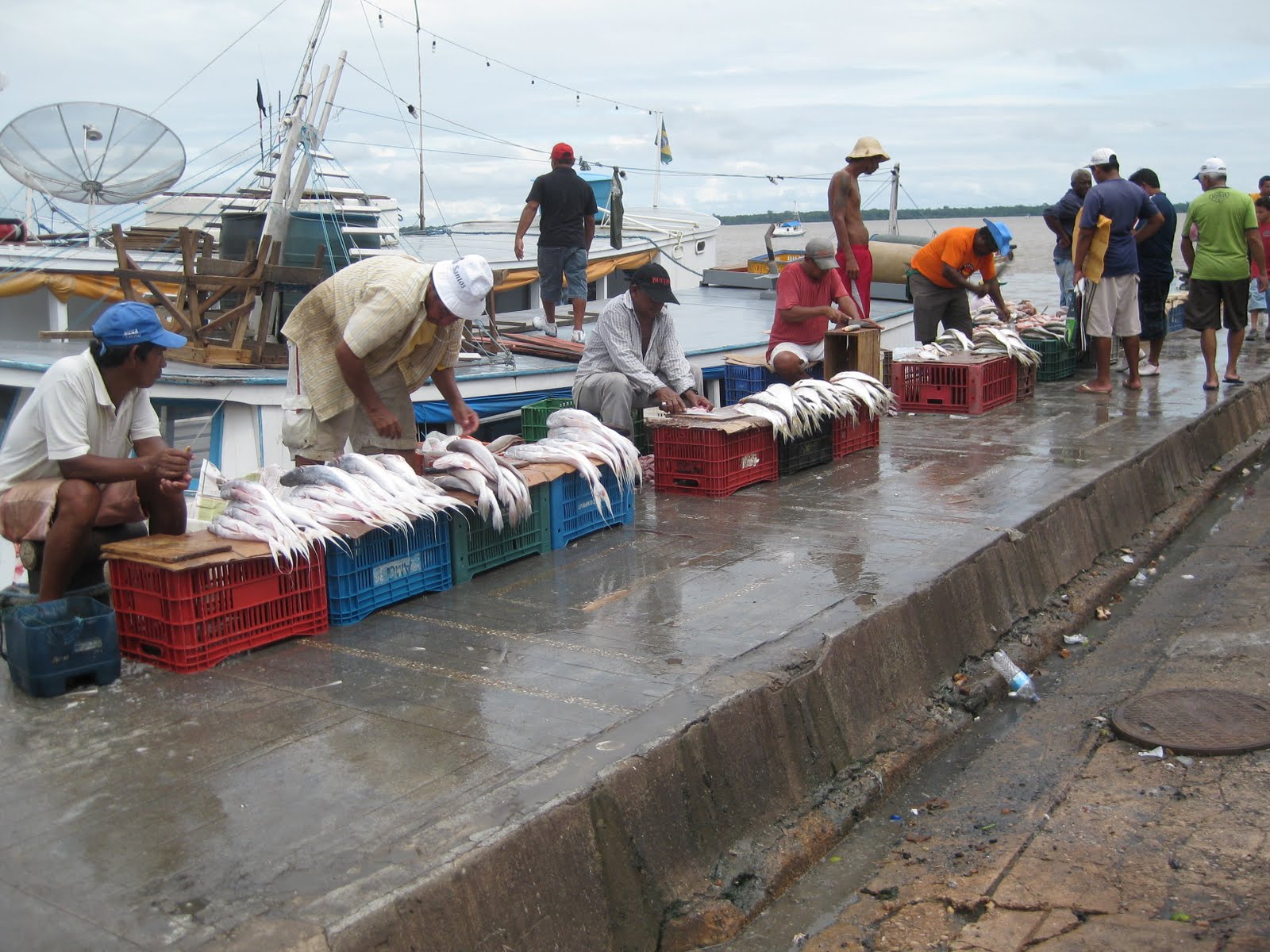
In any case, the last above photo is taken from the Fishermans’ Wharf area around Ver-o-Peso, pictured below. This area stands between Ver-o-Peso and the fort; the latter was a nice place, but didn’t seem to warrant the price of admission.


Oh, and in case you’re wondering, I haven’t really changed. Below, I’m standing in front of the Casa das Onze Janelas, or the House of Eleven Windows. It’s a former mansion-turned military hospital-turned chic art gallery and pricey restaurant.


In selecting among museums, I went straight for the Pará State History Museum. It reminded me of the state history museum in Santa Catarina (oh, 1,800 miles away or so). In both cases, the state history museum is the old governor’s mansion, with plaques and exhibits on the development and uses of the mansion, but with very little actual state history. I was disappointed, but the nice guard let me (the only guest at the time) break the no-photographs rule if I took pictures without my flash. Below is the entrance staircase, with various marbles imported from Italy.


I should say that another example of this museum-as-old-fancy-residence genre is the Imperial Palace in Petrópolis, RJ, which is very worthwhile.

I had planned to take more photos and continue my walk, but the camera’s battery decided that it was finished for the day. On Sunday, I did go by the Teatro da Paz, in the Praça da República nearby my hotel, and I got a final photo of my favorite example of belle epoque architecture in Belém. (Quick history: Belém in the turn-of-the-century grew rich off a boom in the demand for rubber tires, which was limited to one worldwide supply in the Amazon. The city prospered, and rich rubber barons built elaborate homes in a town that came to be known as “the tropical Paris.” It all ended when an Englishman smuggled a rubber tree sapling out of Brazil and to Southeast Asia, to be planted far from the plant’s natural enemies/predators. Leeson of the story: never trust the English.


Pará is also recently famous as the site of most of that factoid I always heard growing up: one football field worth of rainforest was being destroyed every 10 minutes or so. Pará is home to the greatest extent of rainforest desmatamento (Portuguese for deforestation).

So I wasn’t surpised to look up and see this NGO was in town.


I’m now in São Luís, Maranhão, after a 16-hour bus ride. It was supposed to be a 12-hour bus ride. The bus broke down and we had to take a detour because the main road was flooded. I’m very secure in my decision to fly on to Fortaleza now, and not bother with the 20-hour bus ride.

More about São Luís soon. In short, as I had expected, it’s very much a little Salvador.

Wednesday, April 14, 2010

Buffalo in the Amazon Basin: Ilha de Marajó, Pará

Leaving Salvador, mono, lethargy, and Easter behind, I arrived in Belém late Monday night. My plan to connect through São Paulo and thereby pick up a Vivo SIM Card with the Sáo Paulo area code (11) failed. TAM Airlines's computer system crashed nationwide, which made all planes late and shortened my connection time. And Guarulhos terminals are still, well, Guarulhos terminals. They have a pub, a magazine shop, a duty-free shop, and that's about it. (Guarulhos, for the uninitiated, is the busiest airport in the country, located in an adjacent suburb of São Paulo. The city has another domestic-only airport - the second-busiest in the country - in the south end of the megacity.)

So I arrived in Belém at 2 AM on Tuesday, and paid through the nose (R$90) for an okay hotel with a wireless connection only in the lobby and a generous breakfast spread.

I'm as far north as I'll be for the entire trip. Belém sits at about 1 degree of latitude south of the equator.

It was a low-quality first week, in terms of work. Due to the Easter holiday, my letter requests for interviews hadn't arrived and so peole didn~t expect me to call. I ended up sending multiple follow-up emails, which set back the days in which I could make requests. My late arrival didn't help.

Despite the work troubles, I've been quite taken with Belém. It's my kinda town. There are trees along the sidewalk for shade, a grid-like layout (though not as straight and orderly as Campo Grande), public plazas and parks, and enough compactness to put most sites - both touristy and work-related - in walking distance. Were Belém in the US, it would receive a high walkability score.

---

I decided to use my first weekend in town to, er, leave town. Belém sits on the southern part of the Amazon River delta. The delta (drainage basin) is immense. It's difficult to overstate just how much fresh water is coming out of the rainforest.

Anyway, in the middle of the Basin is the Ilha (Island) of Marajó, the largest littoral island in the world, and a landmass approximately the size of Switzerland. The island's main attractions are water buffalo, their meat and cheese, and isolated beaches. (Belém, a city with a working port, has no beaches and some not insubstantial water pollution.)

So I arrived at the River Terminal early at 6 AM on Saturday to catch the 6:30 AM ferry to Camará. I had three objectives for the weekend: see buffalo, eat buffalo, and go swimming.

The ferry ride took three hours and was pretty boring. You can see the sights below. I left my computer and all books back in luggage storage in Belém, and thus had nothing to entertain me. Well, that's not entirely accurate. My phone has Sudoku puzzles as its only free game. I don't really see the attraction of Sudoku. I play it when I'm waiting in line for things like vaccinations and grocery check-out. It's a pretty formulaic, repetitive game.


Early morning crew in Belém


The Belém skyline behind us.


The view of the riverbank, once we left Belém, looked pretty similar.


At certain points, there were no islands to pass and nothing but fresh river water to the horizon.


Our ferry boat line, going the other way. The blue tarps keep out the intense sun.

Two days before I left, I had an interview with a former Secretary of Transport, who proposed that one could get rich (and should get rich) building a hovercraft/hydrofoil factory in Brazil. Most rivers are large, but not all of them are navigable. The river depth varies, preventing the movement of large (cargo) ships. My interviewee has been part of a group that's trying to dredge the rivers and thus create a northern outlet for the crops of the Center-West (read: soy, wheat, and cotton from Mato Grosso). If they could manage to move cargo ships from the interior through Belém - and the rivers do extend that far - they could drastically cut costs. Belém is far closer to US, European, and Asian markets than are the ports of São Paulo and Paraná.

He didn't really know much about the environmental impacts of such a project. He probably thought they were exaggerated.

In any case, we arrived in Camará on the island about 10 AM, and were herded loudly onto buses going to various destinations. I was headed to Salvaterra, the middle city (only three cities are open to independent tourists; most of the island's interior is preserve or swamp) with stingray-free beaches and a few hotel options.

It's unfair to say that Salvaterra is a one-horse town. There were multiple horses. And multiple buffalo. And multiple really hideous black birds.


One of the horses. And note the ongoing football game behind him.


After arrival, I took a walk to find Praia Grande, the beach of some note and the place, according to Lonely Planet, where one could eat lunch cheaply. (The buffet at my hotel looked rather unappetizing, sitting there for a while in the heat.) I did find the beach, and found some buffalo cooling themselves in the confluence of a small creek and the (fresh water) bay (pictured above).

For lunch, I ordered buffalo carne asada. It came with rice, beans, farofa, buttered spaghetti, and mayonnaise-based potato salad. My hypothesis is that fresh fruit and vegetables (besides mangoes) are costly to import from the mainland, thus the dearth of them. My later visit to the town supermarket, which lacked a produce section, supported this hypothesis. Lunch was, unfortunately, pretty bad. The buffalo was close to carne de sol, and so was pretty salty. The rice, beans, and farofa were standard, but I didn't take a second bite of the spaghetti or the potato salad.

However, it was reasonably priced for a touristy place. It's also not the first time I've ordered a dish meant for two while eating alone.

On the walk back to the hotel, I passed the same buffalo grazing just off the beachfront road. I hoped they would stay there while I went to retrieve my camera.

Of course they did not. I had to wander down the long beach to take pictures from afar. I won't say that they're disappointing, because they can't choose their appearance or species. I will say that they look (and pretty much taste) like cattle.


The aforementioned ugly birds.


I did get a chance to go swimming in the fresh water. The river washes down, as you can imagine, tons of debris from the rainforest. Not all of it rots or is consumed before it reaches the ocean. As a result, a swimmer moving through the water will encounter seeds, leaves, twigs, and even large branches floating on the surface. I have a splinter in my right index finger from my attempt to throw a rough piece of wood out of my way.

The water is also choppy in the afternoon, when the wind picks up. It was much more tranquil when I went swimming the next morning.

I ordered a veggie pizza (with very thinly-sliced vegetables) for dinner and had a vegetarian prato feito (beans, rice, vinagrette, and farofa) for lunch the next day. The hotel breakfast was fruit-less, which is a first for me in Brazil.


An attempt at still life.


"The years you have seen only one set of footprints, my child, is when there was a water buffalo."

---

In the end, however, despite the bad food and the fact that there was nothing much to do, I accomplished all my goals. I most likely won't go back to the island, except perhaps as part of a pampered package tour or if I happen to be stationed in Belém for an extended period of time and want to swim.

I can, however, say that I went swimming in the delta/basin/mouth of the Amazon, which is something.

No, there were no piranhas.

---

I`m back in Belém for another week, and my luck in getting interviewees has (slightly) turned. I might have a chance to see more tourist sites here in Belém, and I've found a cheaper hotel.

Next Monday, I have an overnight bus trip to São Luís, the capital of the neighboring (corrupt, underdeveloped) state of Maranhão. I've already had two email responses from Maranhão to my letters, which portends good things.

So it goes. Or, as the Portuguese version of Kurt Vonnegut's Slaughterhouse-Five translates that phrase, "Coisas da vida" or "E assim por diante."